1) Voutilainen, S., Nurmi, T., Mursu, J., & Rissanen, T. H. (2006). Carotenoids and cardiovascular health. The American Journal of Clinical Nutrition, 83(6), 1265–1271.
2) Anunciato, T. P., & da Rocha Filho, P. A. (2012). Carotenoids and polyphenols in nutricosmetics, nutraceuticals, and cosmeceuticals. Journal of Cosmetic Dermatology, 11(1), 51–54.
3) Honda, M. (2022). Application of E/Z-isomerization technology for enhancing processing efficiency, health-promoting effects, and usability of carotenoids: A review and future perspectives. Journal of Oleo Science, 71(2), 151–165.
4) Ghosh, A., & Honda, M. (2025). A comprehensive review of recent advances and future perspectives on astaxanthin geometrical isomers: Biological activities, isomerization techniques, analytical methods, physicochemical characteristics, and application potential. Food Research International, 118036.
5) Honda, M., Watanabe, Y., Murakami, K., Takemura, R., Fukaya, T., Kanda, H., & Goto, M. (2017). Thermal isomerization pre-treatment to improve lycopene extraction from tomato pulp. LWT, 86, 69–75.
6) Ono, M., Honda, M., Yasuda, K., Kanda, H., & Goto, M. (2018). Production of β-carotene nanosuspensions using supercritical CO2 and improvement of its efficiency by Z-isomerization pre-treatment. The Journal of Supercritical Fluids, 138, 124–131.
7) Kodama, T., Honda, M., Takemura, R., Fukaya, T., Uemori, C., Kanda, H., & Goto, M. (2018). Effect of the Z-isomer content on nanoparticle production of lycopene using solution-enhanced dispersion by supercritical fluids (SEDS). The Journal of Supercritical Fluids, 133, 291–296.
8) Stahl, W., Schwarz, W., Sundquist, A. R., & Sies, H. (1992). Cis-trans isomers of lycopene and β-carotene in human serum and tissues. Archives of Biochemistry and Biophysics, 294(1), 173–177.
9) Ikeda, C., Manabe, Y., Tomonaga, N., Wada, T., Maoka, T., & Sugawara, T. (2020). Evaluation of intestinal absorption of dietary halocynthiaxanthin, a carotenoid from the sea squirt Halocynthia roretzi. Marine Drugs, 18(12), 588.
10)Cooperstone, J. L., Ralston, R. A., Riedl, K. M., Haufe, T. C., Schweiggert, R. M., King, S. A., ... & Schwartz, S. J. (2015). Enhanced bioavailability of lycopene when consumed as cis‐isomers from tangerine compared to red tomato juice, a randomized, cross‐over clinical trial. Molecular Nutrition & Food Research, 59(4), 658–669.
11)Unlu, N. Z., Bohn, T., Francis, D. M., Nagaraja, H. N., Clinton, S. K., & Schwartz, S. J. (2007). Lycopene from heat-induced cis-isomer-rich tomato sauce is more bioavailable than from all-trans-rich tomato sauce in human subjects. British Journal of Nutrition, 98(1), 140–146.
12)Honda, M., Takasu, S., Nakagawa, K., & Tsuda, T. (2021). Differences in bioavailability and tissue accumulation efficiency of (all-E)- and (Z)-carotenoids: A comparative study. Food Chemistry, 361, 130119.
13)Honda, M., Murakami, K., Osawa, Y., Kawashima, Y., Hirasawa, K., & Kuroda, I. (2021). Z-Isomers of astaxanthin exhibit greater bioavailability and tissue accumulation efficiency than the all-E-isomer. Journal of Agricultural and Food Chemistry, 69(11), 3489–3495.
14)Honda, M., Kageyama, H., Zhang, Y., Hibino, T., & Goto, M. (2022). Oral supplementation with Z-isomer-rich astaxanthin inhibits ultraviolet light-induced skin damage in guinea pigs. Marine Drugs, 20(7), 414.
15)Osawa, Y., Nishi, R., Kuwahara, D., Haga, Y., & Honda, M. (2024). Improved flesh pigmentation of rainbow trout (Oncorhynchus mykiss) by feeding Z-isomer-rich astaxanthin derived from natural origin. Journal of Oleo Science, 73(1), 35–43.
16)Honda, M. (2023). Z-Isomers of lycopene and β-carotene exhibit greater skin-quality improving action than their all-E-isomers. Food Chemistry, 421, 135954.
17)Yang, C., Hassan, Y. I., Liu, R., Zhang, H., Chen, Y., Zhang, L., & Tsao, R. (2019). Anti-inflammatory effects of different astaxanthin isomers and the roles of lipid transporters in the cellular transport of astaxanthin isomers in Caco-2 cell monolayers. Journal of Agricultural and Food Chemistry, 67(22), 6222–6231.
18)Nakazawa, Y., Sashima, T., Hosokawa, M., & Miyashita, K. (2009). Comparative evaluation of growth inhibitory effect of stereoisomers of fucoxanthin in human cancer cell lines. Journal of Functional Foods, 1(1), 88–97.
19)Honda, M., Murakami, K., Zhang, Y., & Goto, M. (2021). High-efficiency lycopene isomerization with subcritical ethyl acetate in a continuous-flow reactor. The Journal of Supercritical Fluids, 178, 105383.
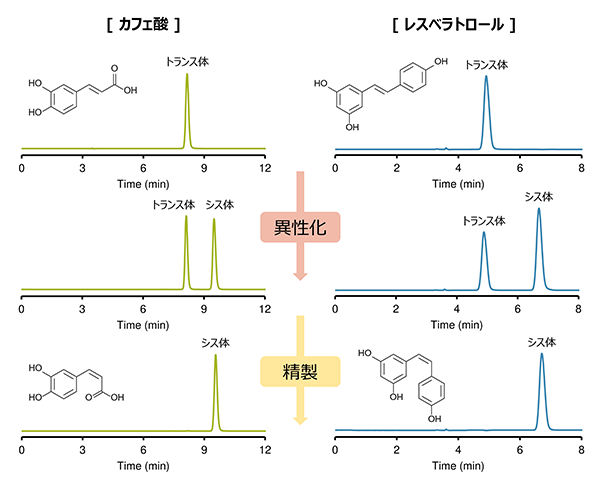
20)Salum, M. L., Mañez, P. A., Luque, F. J., & Erra-Balsells, R. (2015). Combined experimental and computational investigation of the absorption spectra of E- and Z-cinnamic acids in solution: The peculiarity of Z-cinnamics. Journal of Photochemistry and Photobiology B: Biology, 148, 128–135.
21)Flieger, J., Tatarczak-Michalewska, M., & Blicharska, E. (2017). Characterization of the cis/trans isomerization of resveratrol by high-performance liquid chromatography. Analytical Letters, 50(2), 294–303.
22)Park, S., Kim, H., Bang, M., Um, B. H., & Cha, J. W. (2024). A study on the photoisomerization of phenylpropanoids and the differences in their radical scavenging activity using in-situ NMR spectroscopy and on-line radical scavenging activity analysis. Applied Biological Chemistry, 67(1), 69.
23)Leischner, C., Burkard, M., Michel, A., Berchtold, S., Niessner, H., Marongiu, L., ... & Venturelli, S. (2021). Comparative analysis of the antitumor activity of cis- and trans-resveratrol in human cancer cells with different p53 status. Molecules, 26(18), 5586.
24)Ghosh, A., Nishida, Y., Maoka, T., Uragami, C., Hashimoto, H., & Honda, M. (2025). Development of a simple and economical analytical method for investigating the distribution of astaxanthin E/Z-isomers in foods and cosmetics. Journal of Food Composition and Analysis, 137, 106932.
25)Lamuela-Raventos, R. M., Romero-Perez, A. I., Waterhouse, A. L., & De La Torre-Boronat, M. C. (1995). Direct HPLC analysis of cis-and trans-resveratrol and piceid isomers in Spanish red Vitis vinifera wines. Journal of Agricultural and Food Chemistry, 43(2), 281–283.