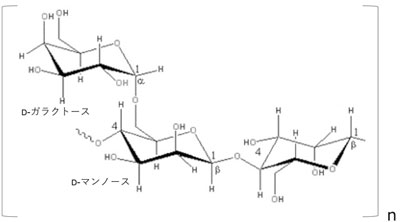
PHGGは1990年代前半より、様々な研究者より生理機能が見出されてきた。PHGGの腸内細菌に対する作用は、1994年にOkubo et al. 9)が、ヒトがPHGGを摂取した時に糞便中の善玉菌であるBifidobacterium spp.の割合が増加することを培養法により明らかにしている報告が最初である。PHGGの短鎖脂肪酸産生促進効果については、Velázquez et al.10)とAnne et al.11)は、他の食物繊維と比較して短鎖脂肪酸、特に酪酸の産生が高いことを明らかにしている。その後、分子生物学的手法により、PHGGを資化する腸内細菌、特に酪酸を産生する酪酸生成菌をターゲットとした解析がなされている。Ohashi et al.12)は、PHGGを摂取させたヒトの糞便からDNAを抽出し、腸内細菌の変動をリアルタイムPCR法により検索し、Clostridium coccoides、Bifidobacterium、Butyryl-CoA CoA-transferase gene、Roseburia/Eubacterium rectale group、Eubacterium halli、Butyrate-producing bacteria SS2/1が増加することを明らかにした (表1)。E. halli、unnamed butyrate-producing bacteria SS2/1は乳酸を原料とする経路で酪酸を産生するが、それ以外の細菌は乳酸を介さずにPHGGを直接資化して酪酸を産生する。このため、PHGGは乳酸発酵を行う乳酸菌やビフィズス菌の保持が少ない人でも酪酸産生が効率的に行われることとなり、管腔内で酪酸が産生されやすいといえる。
表1 グアーガム分解物摂取による腸内細菌の変動
細菌
摂取前
摂取2週間
摂取後2週間
Clostridium coccoides group
12.4 ± 0.1a
12.6 ± 0.1b
12.7 ± 0.1b
Clostridium leptum subgroup
12.6 ± 0.2a
12.8 ± 0.1a
12.8 ± 0.2a
Clostridium cluster I
9.9 ± 0.2a
10.0 ± 0.1a
10.0 ± 0.1a
Clostridium cluster XI
9.0 ± 0.2a
9.3 ± 0.1a
9.0 ± 0.2a
Bacteroides fragilis group
12.6 ± 0.1a
12.6 ± 0.1a
13.0 ± 0.2a
Atopobium cluster
9.0 ± 0.2a
9.1 ± 0.3a
8.8 ± 0.2a
Prevotella
9.6 ± 0.4a
9.6 ± 0.4a
9.3 ± 0.5a
Enterococcus
8.5 ± 0.3a
8.5 ± 0.3a
8.1 ± 0.3a
Lactobacliius group
8.0 ± 0.4a
8.3 ± 0.4a
7.6 ± 0.3a
Bifidobacterium
11.0 ± 0.2a
11.7 ± 0.2b
11.3 ± 0.2c
Butyryl-CoA CoA-transferase gene
11.8 ± 0.2a
12.3 ± 0.2b
12.5 ± 0.3b
Roseburia/Eubacterium rectale group
10.2 ± 0.2a
10.6 ± 0.1b
10.6 ± 0.4a
Faecalibacterium prausnitzii
11.7 ± 0.2a
12.0 ± 0.1a
12.0 ± 0.2a
Eubacterium hallii
9.9 ± 0.1a
10.3 ± 0.1b
10.4 ± 0.2b
Butyrate-producing bacterium strain SS2/1
9.0 ± 0.4a
9.4 ± 0.4b
9.7 ± 0.5b
数値は糞便1g中の遺伝子のコピー数の常用対数値であり、平均値±標準誤差で示した。
異なる上付き文字は統計的に有意差を認めた (a, b, c: p< 0.05)
Ohashi Y, Sumitani K, Tokunaga M, Ishihara N, Okubo T, Fujisawa T. Consumption of Partially Hydrolysed Guar Gum Stimulates Bifidobacteria and Butyrate-producing Bacteria in the Human Large Intestine. Benef. Microbes 6 (4): 451-455 (2015)を改変引用。
4) Koh A et al. From dietary fiber to host physiology: Short-chain fatty acids as key bacterial metabolites. Cell 165 (6): 1332–1345 (2016).
5) Kennedy PJ et al. Kynurenine pathway metabolism and the microbiota-gut-brain axis. Neuropharmacol. 112 (Pt B): 399-412 (2017)
6) Wang Y, Yang Z. Microbial metabolites and the gut-brain axis in neurological disorders: Implications for neuropharmacology and therapy. Neuropharmacol. Ther. 2025 (2): 66-84 (2025)
8) Lal G et al. Guar gum valuable for pharmacological and pharmaceutical conscious: A review. J. Pharmacogn. Phytochem. 10 (1): 7-13 (2021)
9) Okubo T et al. Effects of partially hydrolyzed guar gum intake on human intestinal microflora and its metabolism. Biosci. Biotechnol. Biochem. 58 (8): 1364-1369 (1994)
10)Velázquez M et al. Effect of oligosaccharides and fibre substitutes on short-chain fatty acid production by human faecal microflora. Anaerobe 6 (2): 87-92 (2000)
11)Anne M et al. Comparison of different fibers for in vitro production of short chain fatty acids by intestinal microflora. J. Med. Food 8 (1): 113-116 (2005)
12)Ohashi Y et al. Consumption of Partially Hydrolysed Guar Gum Stimulates Bifidobacteria and Butyrate-producing Bacteria in the Human Large Intestine. Benef. Microbes 6 (4): 451-455 (2015)
13)Ahlawat S et al. Gut-Organaxis: A Microbial Outreachandnetworking. Lett. Appl. Microbiol. 72 (6): 636-668 (2021)
14)Inoue R et al. A preliminary investigation on the relationship between gut microbiota and gene expressions in peripheral mononuclear cells of infants with autism spectrum disorders. Biosci. Biotechnol. Biochem. 80 (12): 2450-2458 (2016)
15)Inoue R et al. Dietary supplementation with partially hydrolyzed guar gum helps improve constipation and gut dysbiosis symptoms and behavioral irritability in children with autism spectrum disorder. J. Clin. Biochem. Nutr. 64 (3) 217-223 (2019)
16)Komiya S et al. Characterizing the gut microbiota in females with infertility and preliminary results of a water-soluble dietary fiber intervention study. J. Clin. Biochem. Nutr. 67 (1): 105-111 (2020)
17)Okamura T et al. Partially hydrolyzed guar gum suppresses the development of sarcopenic obesity. Nutrients 14 (6): 1157 (2022)
18)Hung TV, Suzuki T. Dietary fermentable fibers attenuate chronic kidney disease in mice by protecting the intestinal barrier. J. Nutr. 148 (4): 552-561 (2018)
19)Takayama S et al. Partially hydrolyzed guar gum attenuates non-alcoholic fatty liver disease in mice through the gut-liver axis. World J. Gastroenterol. 27 (18): 2160-2176 (2021)
20)Abe A et al. Partially hydrolyzed guar gum is associated with improvement in gut health, sleep, and motivation among healthy subjects. J. Clin. Biochem. Nutr. 72 (2):189-197 (2023)
21)Morishima S et al. Partially hydrolyzed guar gum suppresses binge alcohol-induced liver fat accumulation via gut environment modulation in mice. J. Gastroenterol. Hepatol. 39 (12): 2700-2708 (2024)
22)Kapoor MP et al. Dietary intervention of prebiotic partially hydrolyzed guar gum improves skin viscoelasticity, stratum corneum hydration, and reduction of trans-epidermal water loss: A randomized, double-blind, and placebo-controlled clinical study in healthy humans. J. Clin. Biochem. Nutr. 76 (1): 96-115 (2025)
23)Morishima S et al. Partially hydrolyzed guar gum ingestion suppresses atopic dermatitis-like symptoms through prebiotic effect in mice. J. Clin. Biochem. Nutr.76 (3): 280-288 (2025)
24)Katagiri R et al. Dietary fiber intake and total and cause-specific mortality: the Japan Public Health Center-based prospective study. Am. J. Clin. Nutr. 111 (5): 1027-1035 (2020)
25)Yamagishi K et al. Dietary fiber intake and risk of incident disabling dementia: the circulatory risk in communities study. Nutr. Neurosci. 26 (2):148-155 (2023)